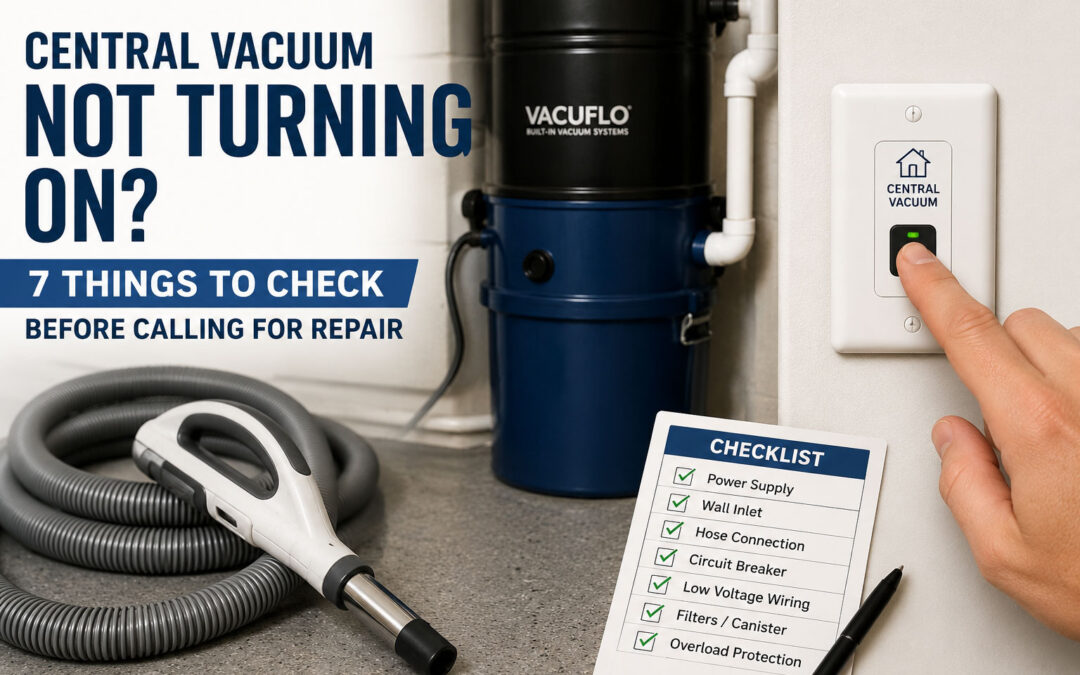
You plug in the hose, flip the switch, and… nothing.
A central vacuum not turning on can be frustrating, but it doesn’t always mean the motor or power unit has failed. Sometimes the problem is as simple as a tripped breaker, a hose connection, or an issue at one wall inlet.
Before scheduling a repair, there are a few simple things you can check yourself. These steps can also help narrow down the problem so a technician has a better idea of what may be happening.
Here are seven things to check when your central vacuum won’t turn on.
1. Check the Circuit Breaker
Start with the simplest possibility: power.
Central vacuum power units typically plug into a standard electrical outlet, often in a basement, garage, utility room, or mechanical area. The circuit supplying that outlet may have tripped even if you haven’t noticed another electrical problem in the house.
Check your home’s electrical panel and look for a tripped breaker.
If you find one, reset it once and test the central vacuum again.
If the breaker immediately trips again, don’t continue resetting it. Repeatedly tripping a breaker could indicate an electrical problem with the power unit, motor, wiring, or circuit that should be professionally diagnosed.
2. Make Sure the Power Unit Has Electricity
If the breaker looks fine, go directly to the central vacuum power unit.
Make sure the power cord is firmly plugged into the outlet. If the system has a power switch, verify that it hasn’t accidentally been turned off.
You can also determine whether the outlet itself is working by testing it with another small electrical device that you know works.
If the outlet has no power, the problem may be with the home’s electrical circuit rather than the central vacuum.
If the outlet works but the vacuum doesn’t, continue troubleshooting.
3. Test More Than One Central Vacuum Inlet
This is one of the easiest ways to narrow down a central vacuum problem.
Try connecting your hose to several wall inlets throughout the house.
If the vacuum turns on from some inlets but not others, that’s useful information. The power unit itself is probably capable of running, and the problem may instead involve a particular inlet or the low-voltage wiring connected to it.
If none of the central vacuum inlets turn the system on, the problem is more likely to be somewhere else, such as the hose, low-voltage circuit, control board, relay, or power unit.
4. Check the Central Vacuum Hose
Depending on your system, inserting the hose into the wall inlet may automatically turn on the vacuum, or you may have an on/off switch located on the hose handle.
If your system uses a switched hose, try moving the switch between positions a few times.
A worn switch, damaged hose connection, or electrical contact problem can prevent the signal from reaching the central vacuum power unit.
If you have another compatible hose available, testing it can help determine whether the problem follows the hose.
This is especially worth investigating when the central vacuum seems completely dead from the hose but the power unit can still be operated manually.
5. Inspect the Wall Inlet
Central vacuum wall inlets do more than provide suction. On many systems, small low-voltage contacts inside the inlet tell the power unit when it’s time to turn on.
Over years of use, an inlet can become loose, worn, damaged, or disconnected.
Look for obvious issues such as:
- A loose or damaged inlet cover
- Bent or damaged contacts
- A hose that no longer fits securely
- An inlet that feels different from the others in the house
If one inlet doesn’t work but the rest do, there’s a good chance the problem is isolated to that inlet or its wiring.
Avoid taking apart electrical components unless you’re comfortable doing so. A central vacuum system uses both household electrical power and low-voltage control wiring, and diagnosing anything beyond an obvious loose or damaged part is usually best left to a technician.
6. Test the Power Unit Directly
Many central vacuum power units have a manual on/off switch located directly on the unit.
Try turning the vacuum on there.
If the power unit turns on manually
That’s an important clue.
The motor is capable of running, so the problem may be in the low-voltage control side of the system. Possible causes include the hose switch, wall inlet contacts, low-voltage wiring, relay, or control board.
If the power unit doesn’t turn on manually
If you’ve already confirmed that the electrical outlet has power, the problem may be inside the central vacuum power unit.
Potential causes can include:
- A failed motor
- Worn motor components
- A defective relay
- Control board failure
- Internal electrical problems
- An overheating or motor protection issue
At this point, professional diagnosis usually makes more sense than continuing to take the system apart.
7. Think About What Happened Before the Vacuum Stopped Working
The symptoms leading up to the failure can tell you a lot.
Did the vacuum suddenly stop in the middle of cleaning?
Had it been shutting itself off and restarting?
Was the motor getting louder?
Did you notice a burning smell?
Had suction become weaker over the previous few months?
Is the central vacuum system 15, 20, or even 30 years old?
A central vacuum that suddenly won’t turn on after years of gradually getting louder or losing performance may have a different problem than a newer system that stopped working without warning.
If you call for service, mention anything unusual you noticed before the system stopped working. Those details can help with diagnosis.
When Should You Call for Central Vacuum Repair?
If you’ve confirmed that the unit has power and tried multiple wall inlets but the central vacuum is still not turning on, it’s probably time to have the system diagnosed.
The good news is that a central vacuum that won’t start doesn’t necessarily need to be replaced.
Depending on the system’s age and condition, the problem may be repairable by replacing or repairing a component such as a motor, relay, control board, inlet, hose, or low-voltage connection.
Older central vacuum systems can often be repaired or upgraded without replacing the tubing installed inside the walls.
That’s why it’s worth having the system evaluated before assuming you need an entirely new central vacuum.
Central Vacuum Repair in Massachusetts
At Certified Vacuum, we’ve been working with vacuum systems for decades. We diagnose and repair central vacuum systems throughout our Massachusetts service area, including older systems where replacement parts or the original manufacturer may be difficult to identify.
We can help diagnose problems with central vacuum motors, power units, hoses, wall inlets, low-voltage wiring, clogs, switches, and other components.
If your central vacuum won’t turn on and you’ve already checked the basics, contact Certified Vacuum to schedule service.
A professional diagnosis can tell you whether you’re dealing with a simple repair, a motor or control issue, or a system that’s reached the point where upgrading the power unit makes more sense.